


对话
전북도 대변인 오재승·도립미술관장 이기전·국악원장 왕기석_我的网站

A | 대변인에 오재승 전 전북교육청 대변인도립미술관장에 이기전 전 전북문화관광재단 대표이사도립국악원장에 왕기석 전 국립민속국악원장 전북도청 전경. 전북도 제공민선 9기 전북도가 개방형 직위 공개모집을 통해 대변인과 도립미술관장, 도립국악원장 최종 합격자를 발표했다.26일 전북도는 대변인(4급 상당) 임용시험 최종 합격자로 오재승 전 전북교육청 대변인을 공고했다.오 전 대변인은 전라고등학교와 원광대학교 법학과를 나와 전라일보에서 기자 생활을 한 뒤 전주시청 홍보관리담당, 전북도청 공보관 등을 지냈다. 대변인은 도정 주요 정책과 현안에 대한 언론 브리핑을 비롯해 언론 소통·대응 등을 총괄하는 핵심 보직이다. 이원택 도정의 방향성과 소통 방식을 가늠할 수 있는 자리로 평가된다.도립미술관장에는 이기전 전 전북문화관광재단 대표이사가 뽑혔다. 그는 전주영생고와 경희대 미술교육과를 졸업하고 같은 대학원 석사 과정을 밟았다.도립국악원장 자리에는 국립민속국악원장을 지낸 왕기석 명창을 임용한다. 왕 명창은 전북도 무형유산 제2호 판소리 수궁가 예능보유자로 KBS국악대상 대상(2014), 제31회 전주대사습놀이 전국대회 판소리 명창부 장원(2015), 대한민국 문화예술상(2017) 등을 수상했다.이들 임용예정자는 신원조회를 거쳐 오는 9월 초 임용될 예정이다.※CBS노컷뉴스는 여러분의 제보로 함께 세상을 바꿉니다. 각종 비리와 부당대우, 사건사고와 미담 등 모든 얘깃거리를 알려주세요.이메일 : [email protected]카카오톡 : @노컷뉴스사이트 : https://url.kr/b71afn。

B |
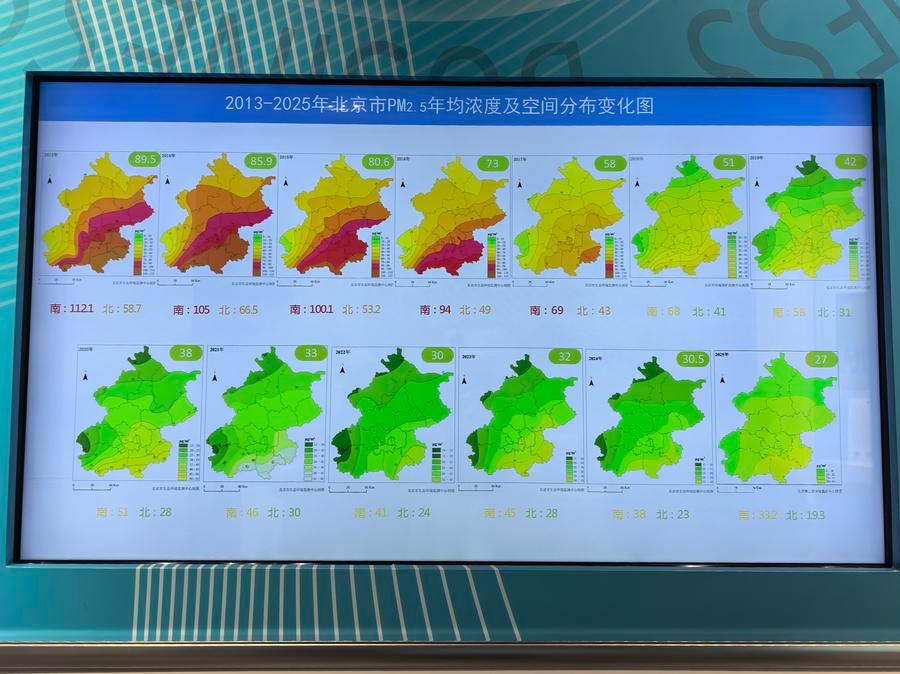
In 2025, Beijing recorded 311 days with good air quality and only one heavily polluted day, compared with 58 heavily polluted days in 2013, when the city officially began releasing PM2.5 monitoring data. The annual average PM2.5 concentration, a key indicator of air quality, fell from 89.5 micrograms per cubic meter in 2013 to 27 micrograms per cubic meter in 2025, a decline of nearly 70 percent.
The progress has drawn international attention. The United Nations Environment Programme has highlighted Beijing's experience in improving air quality as a model for other cities.
According to experts at the Beijing Municipal Ecological and Environmental Monitoring Center, the cleaner air is the result of a comprehensive system integrating environmental monitoring, scientific analysis, policymaking, regional cooperation and law enforcement -- with digital technologies now woven into every link of that chain.
MORE TARGETED APPROACH
Effective governance begins with accurate monitoring. Beijing has established a multi-level air-quality monitoring network. Figures show 35 standard monitoring stations across the city continuously measure six major pollutants, while more than 1,000 compact sensors deployed across communities and townships provide more detailed information on local air-quality variations.
The monitoring system was gradually built by the Beijing Municipal Ecological and Environmental Monitoring Center, one of China's earliest ecological and environmental monitoring institutions, responsible for monitoring Beijing's air, water, noise, soil environments and ecosystems.
The center has developed an analytical system that can identify around 125 components of PM2.5, covering most of its composition and helping researchers trace pollution sources.
"Source analysis helps us identify the major contributors to pollution at different stages, providing a scientific basis for policymakers to target key emission sources," said Li Yunting, technical director at the center.
Coordinated by the Beijing Municipal Ecology and Environment Bureau, the center has conducted four rounds of PM2.5 source analysis studies with other institutions, with results released in 2014, 2018, 2021 and 2025.
The latest analysis showed that regional transport contributed 57 percent of Beijing's PM2.5 pollution. Among local sources that accounted for the remaining 43 percent, vehicle emissions and residential sources represented the largest share of pollution, a distinctive characteristic of a major international metropolis.
The monitoring results have provided scientific support for a series of pollution-control measures. For example, Beijing has promoted new-energy vehicles to reduce transport emissions and adopted advanced techniques, including air-supported membrane structures, to control dust emissions. Meanwhile, coal combustion pollution, once a major contributor, has almost been eliminated and is no longer listed among the main sources, reflecting broader national efforts to reduce coal consumption, promote clean energy and upgrade heavily polluting industries.
With PM2.5 concentrations now at relatively low levels, further gains in air quality will depend on more targeted, science-driven approaches.
SMARTER ENVIRONMENTAL GOVERNANCE
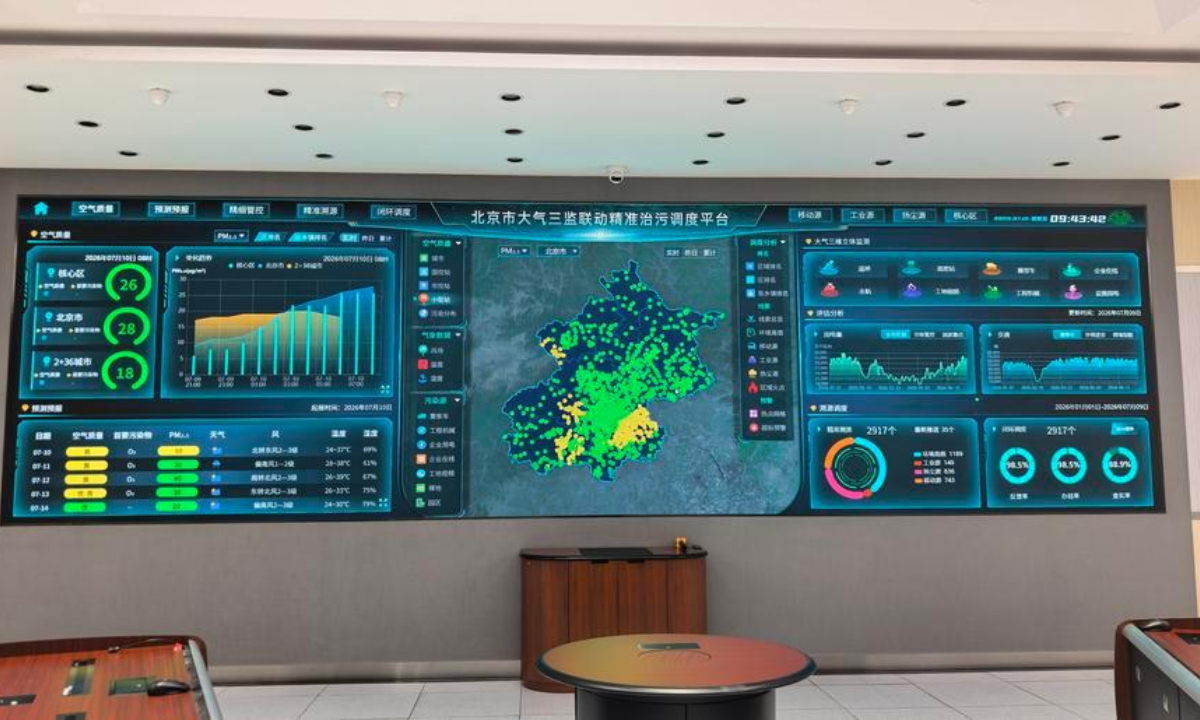
Beyond monitoring pollution, Beijing has built a data-driven environmental governance system that links monitoring, regulation and enforcement in a closed loop from detection to action and follow-up evaluation.
Developed by the center and known as the innovative regulation-monitoring-inspection linkage model, the system integrates artificial intelligence, the Internet of Things, satellite remote sensing and vehicle-mounted monitoring technologies to pull together environmental data from multiple sources onto a unified platform.
"The system brings information that was once scattered across different departments onto a single platform," said Zhang Likun, director of the smart system division at the center, adding that this enables off-site enforcement and joint cross-sector actions involving housing, water resources and transportation, significantly improving the efficiency and precision of environmental management.
Using more than 30 intelligent algorithms, the platform automatically analyzes data and identifies potential pollution risks, based on which monitoring staff identify the most pressing problems and forward them to enforcement departments.
The approach has already drawn international attention. Clean Air Asia, an international nongovernmental organization focused on improving air quality across Asia, featured the system as a representative case study in its "China Air 2025" report. The model was also presented at the 2026 Better Air Quality Conference and recognized with the Certificate for Clean Air Best Practice Sharing.
China has integrated ecological conservation into its modernization drive. As the country speeds up efforts under the Beautiful China Initiative, Beijing's experience demonstrates how technology can support more precise, coordinated and sustainable environmental governance.
。
Current article:http://nzg1.zhenzongtingrangunhongqiusao.shop/v7ywj6i/slfi.html
Published on:20:45:46
 Top European Hotels Fight for Staff, Left With No Choice But To Hire Inexperienced Workers
 《魔法门之英雄无敌III重制版》正式公布!全程中配 两部DLC
 上海:加快具身智能技术熟化 加强智能机器人自主全产业链布局
 2024·第228篇丨二幼【精彩活动】 凝心聚力,拔出精彩
 澳门举办国际青少年演艺节 助力青年文艺互通互鉴
 2026暑期档连续46天单日票房过亿 观影人次、放映场次双双刷新历史
 媒体人:三方交易载历史 如今王岚嵚祝铭震去山东 郭艾伦离开广州
 济宁:提升工会干部队伍法律素质 赋能维权服务能力
 离开卡上线不远:小米穿戴设备确认将支持成都天府通 NFC 交通卡
 哪些山区景区危岩拦截被动防护网服务商适配项目需求
 Meta和英伟达联手押注AI材料 发力半导体下一代制造材料
 受权发布丨国务院关于修改和废止部分行政法规的决定